
La Salle County Court Records After a Jail Arrest
A jail arrest starts a custody record, not the final court file. The La Salle County Jail booking may show or confirm why someone was taken into custody, but the filed court records are created when the prosecutor brings a complaint, information, indictment, or other charging document into the correct court. The 81st Judicial District Attorney handles felony prosecution for LaSalle and neighboring counties, while the county attorney role is tied to misdemeanor prosecution and county-level legal duties.
That distinction matters because booking charges and court charges can diverge. A prosecutor may reject a case, amend a charge, reduce an offense level, add a count, dismiss a count, seek indictment, or file a different charge than the one first listed at the jail. Use jail inmate records for custody and booking detail, then use court channels for filed charges, case numbers, settings, motions, and dispositions.
The statewide search starting point is shown in the screenshot captured from re:SearchTX.
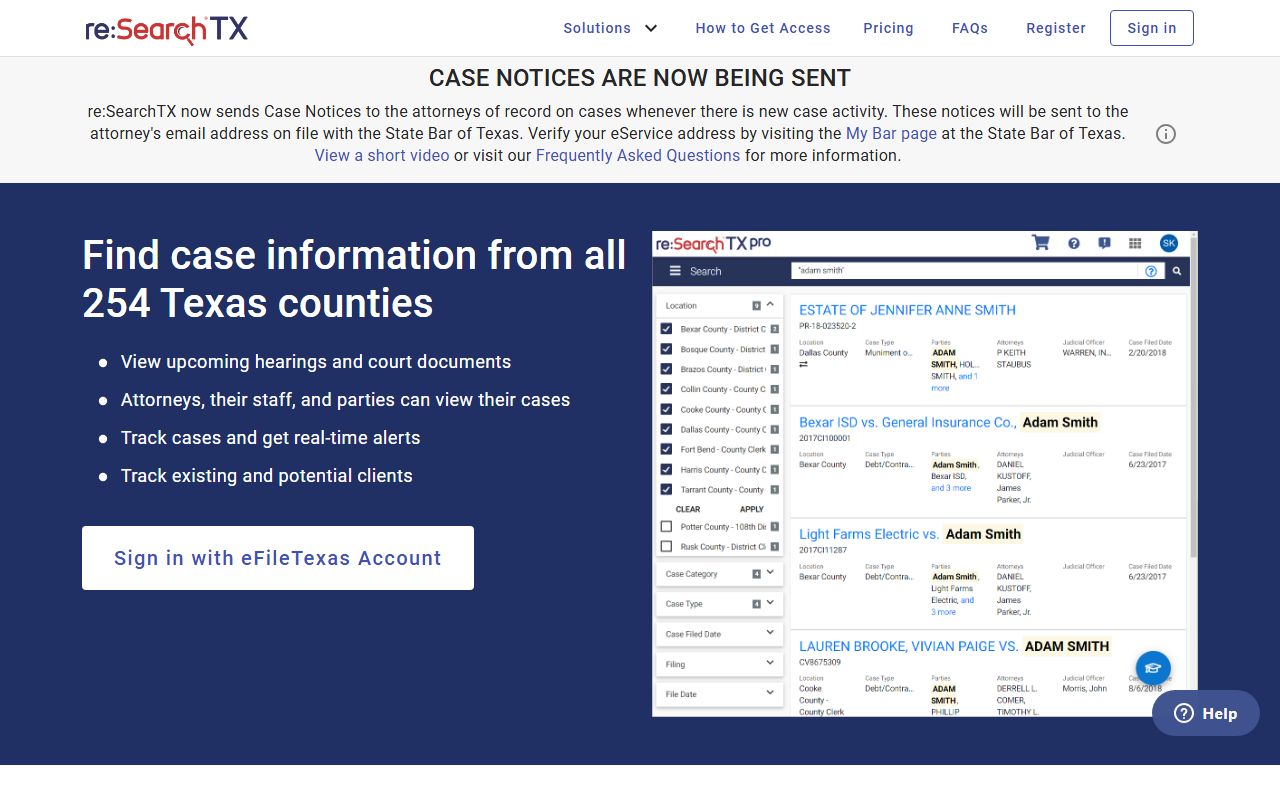
re:SearchTX is useful for integrated public court data, but access level and document availability can vary by court, user role, account status, and record type.
How to Find La Salle County Court Records After an Arrest
Search court records after a La Salle County arrest through re:SearchTX and the County/District Clerk. The clerk is Sonia Maldonado, District & County Clerk, at 101 Courthouse Square #107 in Cotulla. The office phone listed in the research is (830) 483-5120. Published clerk hours are Monday through Thursday from 7:30 a.m. to noon and 1:00 p.m. to 5:00 p.m., and Friday from 8:00 a.m. to 2:00 p.m. The county clerk page also carries docket notices and an expunction-service-party link.
- Search re:SearchTX by defendant name or case information when the case may be integrated into the statewide portal.
- If a cause number is known from a bond document, citation, indictment, complaint, or court notice, use it because it is more precise than a name search.
- Limit the search to La Salle County or the relevant court when filters are available.
- Open the case record and compare filed charges, charge level, hearing dates, bond conditions, attorney entries, and disposition fields.
- Contact the County/District Clerk when the statewide portal is incomplete, when document access is restricted, or when the next setting must be confirmed.
- Use the DPS conviction-name-search portal only as a separate criminal-history channel; it is not the same as the live court file or the jail roster.
Court dockets can change, and a jail release date does not prove the court case is over. Bond, personal recognizance release, dismissal, transfer, or sentence completion are different events. Always verify the court record before relying on an old booking entry.
Who Files Charges After a La Salle County Arrest
The 81st Judicial District Attorney's Office serves Atascosa, Frio, Karnes, LaSalle, and Wilson counties. The official DA site names Audrey Gossett Louis as District Attorney. The DA contact page lists Leslie Carranza as First Assistant and prosecutor for Frio and LaSalle Counties, and Catherine Schneider as a Border Prosecution Unit Attorney for Wilson and LaSalle Counties. The main DA office is listed at 1105 A Street, Floresville, TX 78114, with (830) 393-2200 and weekday hours of 8 a.m. to 5 p.m.
La Salle County Attorney Elizabeth Martinez is listed at 101 Courthouse Square in Cotulla with (830) 483-5127 and Monday through Thursday hours. County attorney and district attorney roles matter because misdemeanors and felonies do not always move through the same prosecutor. A felony arrest may begin in the county jail but later be reviewed and filed through the district attorney and district court process.
How Charges Get Filed After an Arrest: Complaint, Information, and Indictment
Booking happens at the jail. The court record begins when a charging document is filed or when a court takes action on the case. Texas practice uses several charging paths, and the document type can depend on offense level, case stage, and prosecutorial decision. The names below are general court-record terms, not a guarantee about any specific La Salle County case.
| Complaint | Information | Indictment | |
|---|---|---|---|
| Filed By | Officer or prosecutor, depending on stage and offense. | Prosecutor. | Grand jury. |
| Common Use | Early accusation or misdemeanor-related filing. | Many misdemeanor filings and some felony contexts. | Felony prosecution after grand-jury action. |
| Record Function | States the accusation and begins or supports case processing. | Sets out the prosecutor's formal charge. | Charges the offense after grand-jury review. |
| Why It May Differ From Booking | The prosecutor may amend, reject, reduce, add, or dismiss charges after reviewing reports and evidence. | ||
Charge Status in Court Records After an Arrest
Charge status shows where the filed case stands. A status term is not the same as custody status, and it may not match the jail roster. A person can be out of jail while a case is pending, or still in jail because a different hold prevents release. Read each count separately because one charge can be dismissed while another remains active.
| Status | What It Means |
|---|---|
| Pending | The case or count remains active and has not reached final disposition. |
| Filed | A charging document or case record has been accepted by the court. |
| Indicted | A grand jury returned a felony charging instrument. |
| Amended or Reduced | The prosecutor or court changed the charge, count wording, or offense level. |
| Dismissed | The case or count ended without a conviction on that charge. |
| Disposition | The final outcome, such as conviction, dismissal, deferred adjudication, or other court result. |
Bond and Release After an Arrest
Texas Code of Criminal Procedure Chapter 17 governs the broad bail and bond framework. The La Salle sheriff page states that the sheriff accepts bail for prisoners in his custody and, where the county lacks a Bail Bond Board, sets bail-bond policy for the county. For a live case, call the jail at (830) 879-3041 before trying to post bond. Ask for the exact name and date of birth, charges, bond amount, bond type, payment method, posting location, hours, and any separate holds.
| Bond Type | How It Works |
|---|---|
| Cash Bond | Money is paid directly as allowed by local procedure and court order. |
| Surety Bond | A licensed bail agent or surety guarantees appearance, usually for a fee and possible collateral. |
| Personal Bond or PR Bond | Release is based on a promise to appear and comply with conditions, sometimes with supervision. |
| No-Bond Hold | Payment alone will not release the person because of a court order, warrant, parole hold, ICE detainer, or other agency hold. |
Warrants That Lead to an Arrest
No official La Salle County sheriff active-warrant search page was found in the county site or visible iSOMS menu. If a warrant led to a jail arrest, the booking may appear through iSOMS once accessible, but warrant clearance and court settings belong with the issuing court or agency. The sheriff or jail line can help confirm whether someone was booked on a warrant or whether a warrant-related hold affects release.
Justice of the Peace offices may handle lower-level traffic or Class C matters, while County/District Clerk records may show filed case information, court dates, and bench-warrant-related case activity. re:SearchTX can help locate filed court information, but it is not a warrant hotline. GovQA is useful for public-record requests, not urgent surrender or safety questions. Anyone resolving a warrant should contact the issuing court or counsel before appearing in person, because arrest risk and bond availability vary.
Charges vs. Convictions
An arrest and a charge are accusations. A conviction is a final adjudication or plea result. Court records after an arrest may show both dismissed charges and convictions, so read the disposition for each count rather than assuming every filed charge ended the same way.
| Charge | Conviction | |
|---|---|---|
| Stage | Accusation filed or tracked in the case. | Final guilt result by plea, verdict, or adjudication. |
| Proof Standard | Can begin from probable cause and prosecutorial filing decisions. | Requires the criminal-case standard or accepted plea process. |
| Record Meaning | Does not prove guilt. | Shows a completed outcome on that count unless later modified. |
Sealed vs. Expunged Arrest Records
Texas Code of Criminal Procedure Chapter 55 addresses expunction for eligible arrest records. Sealing or nondisclosure can limit public access without always destroying every underlying government record. Expunction is stronger and can require records to be removed or treated as if the arrest did not occur, depending on the order. Eligibility is fact-specific and should be verified through the court, clerk, and legal counsel.
| Sealed or Nondisclosed | Expunged | |
|---|---|---|
| Visibility | Public access is limited by court order or statute. | Eligible records may be destroyed, returned, or treated as nonexistent under the order. |
| Government Access | Some agencies may retain limited access. | Access is much more restricted and governed by the expunction order. |
| Common Trigger | Eligible dispositions under Texas nondisclosure law. | Eligible dismissal, acquittal, non-prosecution, or other Chapter 55 pathway. |
Background Check Considerations
Casual court lookup is not the same as a compliant consumer background check. Court, jail, and public-record databases may be incomplete, delayed, restricted, or corrected after the first posting. Employers, landlords, insurers, lenders, and similar decision-makers must use legally compliant channels and cannot rely on ordinary public lookup material for FCRA-covered decisions.
Important: Do not use jail, court, or custody lookup information for employment, credit, housing, insurance, or any other FCRA-covered purpose.
Restricted Court Records After an Arrest in La Salle County
Texas public access is broad, but it is not unlimited. Juvenile records, sealed cases, expunged arrests, medical information, victim information, active-investigation material, certain law-enforcement details, and confidential identifiers can be withheld or redacted. Texas Government Code Chapter 552, the Texas Public Information Act, supports inspection or copying of government records unless an exception or confidentiality law applies. For filed court records, the clerk and court rules control access. For jail records, the sheriff's office and GovQA request process are the practical fallback when online material is missing.